Menu
Are you looking to bring the colors of your home to life, but are unsure how to start? Well, I’ll let you in on my secret today. The perfect way to bring your colors to life are done with the power of light.
You may ask, why with light and not just adding furniture or ornaments in this color. Why not just paint my walls?! The easy answer to that is, I personally like subtle accents of colors while keeping the room serene and neutral. So, I had to find a way in which I was able to have both a neutral colored home and a colorful home. And lighting can be just that powerful tool for bringing out the best in any color and highlighting it in your space.
Light and color theory
Color and lighting are influential elements in interior design, as they can have huge impacts on the overall mood and atmosphere of a space.
Understanding the theory behind how color and lighting interact can help you make decisions when designing a room.
The Color Wheel
First, it’s important to understand the color wheel, which is a visual representation of the different colors and their relationship to one another. At the center we have the primary colors which are red, blue, and yellow. These colors are considered the building blocks of all other colors and cannot be created by mixing other colors together. From the primary colors, we can create the secondary colors by mixing them together. The secondary colors, which are green, orange, and purple. Together, the primary and secondary colors can create tertiary colors.
Lighting
When designing a room, it’s important to consider how color and lighting will interact. So enhancing warm colors can be done by using warm lighting like incandescent bulbs. While cool colors will be enhanced by cool lighting such as LED bulbs. Additionally, different lighting sources can create different moods. You can for instance create a cozy and intimate atmosphere by using a soft light, and if you want to create more of a energetic atmosphere you can use a bright light.
Window Treatment
One more aspect of lighting design to take in consideration is about the natural light that enters your rooms. You can control the amount of natural light that comes in and what ambiance to create with this light through window treatment. You might have heard about window treatment before and if not this refers to any type of covering applied to windows to control light, provide privacy and enhance the overall aesthetic of a space. You can use window treatment in many different ways through various types of window treatments, each with its own unique features and benefits.
The Color Wheel
Within the color wheel we also speak of complementary colors. These colors are those that are opposite of each other on the color wheel. These colors have the greatest contrast and can create a dynamic visual effect when used together.
The color wheel can also be divided into warm and cool colors. Warm colors as reds, oranges, and yellows are associated with warmth and energy. While cool colors as blues, greens, and purples are associated with calmness and tranquility.
One of the most common ways to use the color wheel is to create a color scheme. A color scheme is a combination of colors that work well together. Let me introduce you to a few types of color schemes:
- Monochromatic color scheme uses variations of one color.
- Complementary color scheme uses colors that are opposite to each other on the color wheel.
- Analogous color scheme uses colors that are next to each other on the color wheel.
- Triadic color scheme uses colors that are evenly spaced around the color wheel.
- Split complementary color scheme uses a base color and the two colors on either side of its complement.
- Tetradic – double complementary color scheme uses four colors arranged into two complementary pairs.
- Square color scheme uses four colors that form a square on the color wheel.
- Gradient color scheme uses a gradual change of color.
Overall, the color wheel can be a valuable tool for designing your home by making you understand the basics of color theory and how colors interact with one another. It’s very useful to keep as a red lining in your designing journey.
Lighting
One aspect of lighting design that is very important, is layering different light sources. In which you use multiple sources of light to create depth, texture and interest in your home or to enhance specific elements and architectural features. Here are some ways to do so:
- Ambient lighting: This is the overall general lighting that provides a base level of light in a room. It can come from overhead fixtures, wall sconces or natural light sources like windows.
- Task lighting: This type of lighting is used to make specific tasks or activities more pleasant like reading books, cooking or working at a desk. It’s often provided by table lamps, under-cabinet lights, or wall-mounted fixtures.
- Accent lighting: This type of lighting is used to highlight specific features or elements of a space. Such as artwork, sculptures or architectural details. It’s often provided by spotlights, track lights, or picture lights.
- Decorative lighting: This type of lighting is used to add a decorative element to a space and can include chandeliers, pendant lights or wall sconces.
Each type of lighting serves a different purpose and combining them in different ways can help you to achieve a well-balanced and functional lighting design.
Window treatment
- Curtains and drapes are fabric panels that are hung from a rod or track and are often used to control light and provide privacy. They come in a variety of styles, materials, and patterns and can be lined or unlined, depending on the desired level of light control and insulation.
- Blinds are slats of material and typically made of wood, metal or plastic that are mounted on a frame and can be opened and closed to control light. There are several types of blinds, including horizontal blinds, vertical blinds, and roman shades.
- Shades are similar to blinds but are made of a single piece of material that can be raised or lowered to control light. There are several types of shades, including roller shades, cellular shades and Roman shades.
- Shutters are hinged panels that can be opened and closed to control light and provide privacy. They are often made of wood or synthetic materials and come in a variety of styles, including plantation-style shutters and colonial-style shutters.
- Valances are decorative pieces that are mounted above the window to add an additional layer of decoration and conceal the top of the window treatment. They come in a variety of styles, including swags, jabots and cornices.
Each type of window treatment offers different levels of light control, privacy, and style. Therefore, it’s important to consider your specific needs and preferences when selecting a window treatment.
Conclusion on light and color theory
Color and lighting are powerful tools that you can us to influence the mood and atmosphere of your home. Understanding the theory behind how they interact can help you make decisions when designing a room. It’s important to consider the color wheel, the different moods that can be created through lighting, and the importance of layering different light sources and natural light.
Using light to enhance color
Today I will share 5 ways to highlight colors in your home with one of my favorite colors: Orange.
- Use accent lighting to draw attention to orange accents in your room. This could be a lamp with an orange shade, or a spotlight shining on an orange piece of art. This type of lighting will draw the eye to the orange and make it the focal point of the room.
- Incorporate orange-hued light bulbs into your fixtures. This will give the room a warm and inviting ambiance and make the orange color pop.
- Use dimmer switches to control the intensity of the light. This will allow you to adjust the lighting to the perfect level for any occasion, whether it’s a cozy dinner or a lively party.
- Experiment with colored light filters. These can be placed over light fixtures to change the color of the light. This can be a fun way to play with different shades of orange and create a unique look in your space.
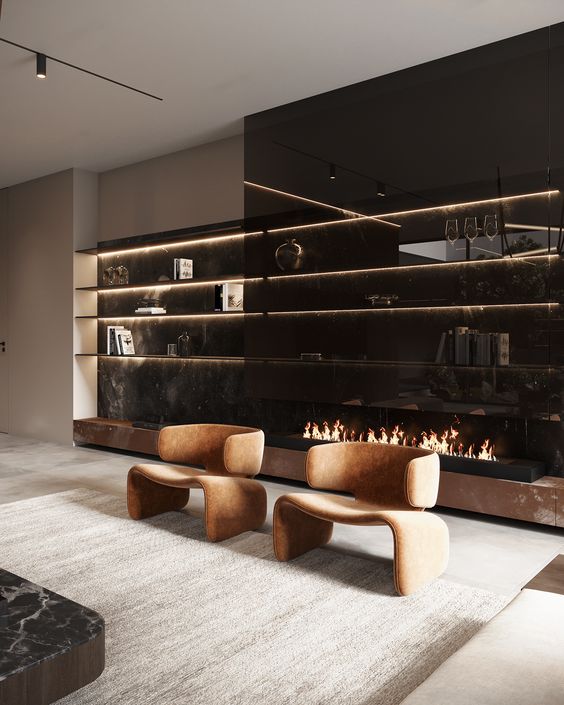
- Use orange lighting as a backdrop. This can be achieved by installing orange-colored light in the background of a room, such as in a bookshelf or behind a piece of furniture, creating an orange-hued ambiance to the room. Which you can see in the bookshelf, bedroom and bathroom pictures in our frame of this week.
The specialty of orange in neutral color pallets
Orange is a bold color that is often used to add a touch of energy, warmth and excitement to a home. In neutral color pallets orange can be that pop of color to incorporate a sense of liveliness, creativity and interest to your home. It can give your home a playful and exciting twist without it being overwhelming. And best of all orange can easily be incorporated in your home through lighting.
Additionally, orange is a complementary color to blue, which is a popular neutral color. So it can also help to balance out a space and create visual interest.
By incorporating lighting techniques that we discussed, you can add a pop of orange to your home and make it feel more playful and energizing. So, don’t be afraid to play around with lighting and color to create the perfect atmosphere in your home.
In conclusion, the many ways in which orange can add warmth, energy and a sense of playfulness to the space in a neutral color palette makes it a versatile and effective color for interior design.
You might also like
Disclaimer
Many or all the products featured on Homespirations are from our partners who compensate us. This may influence which products are written about and where/how the product appears on a page or in a blog. However, this does not influence our evaluation of the products.